Retinol for Beginners: Best Amazon Picks to Start Safely
Last updated: May 23, 2026
This post contains affiliate links. If you purchase through my links, I may earn a small commission at no extra cost to you. I only recommend products I genuinely believe in. Thank you for supporting moodzco.blog!
What is retinol for beginners?
retinol for beginners refers to low-strength retinol formulas and gentle introduction routines designed for first-time users. starting with a lower concentration (0.025%–0.1%) helps your skin build tolerance without irritation, peeling, or redness. most beginner-friendly retinols on amazon are under $30 and work for all skin types.
if you’ve been curious about retinol but scared to try it, you’re not alone. retinol for beginners can feel overwhelming — the purging phase, the “start slow” advice, the 47 different percentages. this guide breaks it all down and rounds up the best beginner retinol products on amazon that are gentle enough to actually stick with.
1. RoC Retinol Correxion Line Smoothing Serum — one of the most recommended beginner retinols for a reason. it uses a low, encapsulated retinol formula that releases slowly into the skin, which means less irritation and more consistent results. dermatologist-approved and fragrance-free. use it 2–3 nights a week to start.
2. Neutrogena Rapid Wrinkle Repair Retinol Serum — a drugstore classic that works. the formula is lightweight and absorbs fast, making it great for oily or combination skin types. pair it with a simple moisturizer after application. one of the most affordable entry points into retinol that consistently gets results.
3. CeraVe Resurfacing Retinol Serum — cerave built this one specifically for beginners — it combines retinol with ceramides and niacinamide to support your skin barrier while the retinol does its work. less purging, less dryness, and a formula that plays nicely with the rest of your routine.
4. Paula’s Choice 0.3% Retinol + 2% Bakuchiol Treatment — if your skin is extra sensitive, this is your retinol. bakuchiol is a plant-based retinol alternative that helps buffer irritation while still delivering results. gentle enough for nightly use once your skin adapts, and it comes in a satisfying pump bottle that makes dosing easy.
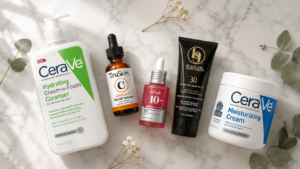
5. TruSkin Retinol Serum — an amazon bestseller with thousands of reviews for a reason. it blends retinol with vitamin c and hyaluronic acid, so you’re getting brightening and hydration alongside the anti-aging actives. great for beginners who want a multi-tasking serum rather than a single-ingredient product.
6. Differin Adapalene Gel 0.1% — technically a retinoid rather than retinol, but worth including because it’s the only prescription-strength retinoid available over the counter in the US. if you want real, clinical results without a dermatologist visit, differin is the upgrade path once your skin is ready. start slow — 2 nights a week max.
7. Olay Regenerist Retinol 24 Night Moisturizer — perfect for beginners who want retinol embedded in a moisturizer rather than a serum. the hydrating base means less dryness and peeling, and the formula is fragrance-free. great as a first step before moving to a standalone retinol serum.
8. La Roche-Posay Retinol B3 Serum — this one pairs retinol with vitamin b3 (niacinamide) to calm any irritation the retinol might cause. french pharmacy brand, gentle formula, works for sensitive skin. it’s on the pricier side for a drugstore pick, but the skin tolerance is genuinely better than most.
the most important thing about starting retinol? go slow. use it once or twice a week, always at night, always followed by spf the next morning. your skin will adjust — and the results are worth the patience. 🤍
Frequently Asked Questions
How often should beginners use retinol? start with once or twice a week, at night only. after 4–6 weeks with no irritation, you can increase to every other night. most beginners reach nightly use after 2–3 months of consistent, gradual introduction.
Can retinol cause breakouts? yes — this is called the purging phase and it’s normal for the first 4–6 weeks. retinol speeds up skin cell turnover, which can temporarily push congestion to the surface. if breakouts persist beyond 6–8 weeks, reduce frequency or switch to a lower concentration.
What should you not use with retinol? avoid combining retinol with vitamin c, AHAs (like glycolic acid), and BHAs (like salicylic acid) in the same routine — it increases irritation risk. use retinol at night and vitamin c in the morning. always follow retinol with moisturizer to support your skin barrier.
What’s the difference between retinol and retinoid? retinol is an over-the-counter form of vitamin a that converts to retinoic acid in the skin. retinoids (like adapalene or tretinoin) are stronger and either prescription-only or available OTC at lower concentrations. beginners should always start with retinol before moving to retinoids.
Where can I find more skincare recommendations like this? moodzco.blog has more skincare roundups, amazon beauty finds, and routine guides curated specifically for beginners and budget-conscious shoppers.